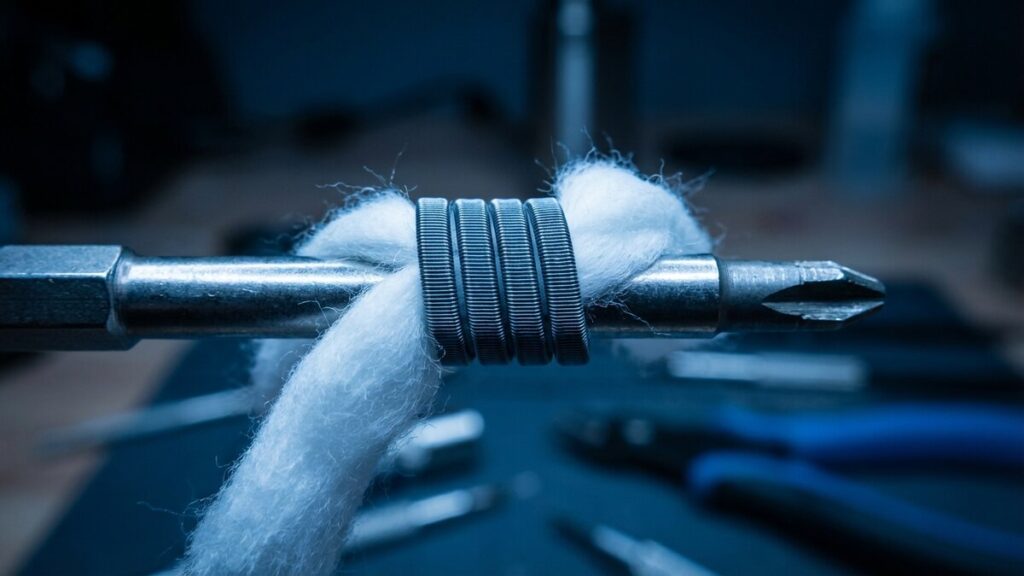
Vape coils are the heart of every vaping device. They are the component that transforms liquid into vapor, and understanding how they work is essential for getting the best possible experience from your setup. Whether you are brand new to vaping or looking to deepen your knowledge, this guide covers everything you need to know about coils and wicking materials.
What Is a Vape Coil?
A vape coil is a piece of resistance wire that is wrapped into a spiral shape. When electricity from the battery passes through the wire, it heats up rapidly. This heat is transferred to the wicking material (usually cotton) that is threaded through or around the coil. The wick absorbs e-liquid from the tank, and when the heated coil contacts the saturated wick, the liquid vaporizes and you inhale the resulting vapor.
In most modern devices, the coil and wick come as a single replaceable unit called a coil head or atomizer head. You unscrew the old one, screw in a new one, and you are back to vaping with fresh flavor. More advanced users build their own coils using separate wire and cotton, but that is a topic for after you have mastered the basics.
When I first quit smoking three years ago, someone handed me a vape and said “just inhale.” Nobody explained coils, resistance, wicking, any of it. I vaped on the same coil for over a month until the flavor was so bad I nearly gave up. It was my wife who googled “why does my vape taste burnt” and figured out I needed to change the coil. That is a true story, and I am not embarrassed by it anymore because I know most beginners go through the same confusion. If you are reading this as a total newbie, you are already ahead of where I was.
Types of Coil Wire
The wire used in vape coils varies by material, and each material has distinct properties that affect performance.
Kanthal
Kanthal is the most common coil wire material and the standard in most pre-built coil heads. It is an iron-chromium-aluminum alloy that heats evenly, holds its shape well, and is easy to work with. Kanthal coils are used exclusively in wattage mode (also called power mode) and are not compatible with temperature control. For most vapers, Kanthal provides a reliable, no-fuss experience.
Quick real-world note on Kanthal: this is what is in the coils for my XROS 4 Mini, and it is in the vast majority of pre-built coils you will find at any shop. You do not need to think about it much. Just know that if someone starts talking about temperature control mode, Kanthal does not work with that. For 90% of vapers using a pod or a basic tank, Kanthal coils in wattage mode is all you need. I used nothing else for my first two years of vaping and had zero issues.
Stainless Steel
Stainless steel is a versatile material that works in both wattage mode and temperature control mode. It heats up quickly, produces clean flavor, and has a lower resistance than Kanthal at the same dimensions. Many vapers consider stainless steel to offer the best overall flavor of any coil material. The 316L grade is the most common in vaping applications.
Nickel (Ni200)
Nickel wire is used exclusively with temperature control. It has a very low resistance and should never be used in wattage mode, as it can overheat and produce harmful compounds. Nickel coils offer precise temperature regulation but are softer and more difficult to work with than Kanthal or stainless steel.
Titanium
Like nickel, titanium is a temperature control wire. It offers better flavor than nickel and is slightly easier to handle, but it must not be heated above 600 degrees Fahrenheit (315 degrees Celsius) as titanium dioxide can form at higher temperatures. Titanium coils are less common than other materials but have a dedicated following among temperature control enthusiasts.
Coil Configurations
Beyond the wire material, the way the coil is built affects vapor production, flavor, and the overall vaping experience.
Single Round Wire
The simplest coil configuration is a single strand of round wire wrapped into a spiral. This is what you will find in most basic coil heads. It provides good flavor and moderate vapor production without requiring high wattage.
Mesh Coils
Mesh coils use a strip of perforated metal sheet instead of traditional wound wire. The mesh provides a much larger surface area in contact with the wick, which translates to faster, more even heating. The result is richer flavor and denser vapor, often at lower wattages than equivalent round wire coils. Mesh coils have become the industry standard for sub-ohm tanks — see our GeekVape coil guide for specific examples due to their superior performance and longevity.
The GeekVape Z Fli 2 Sub-Ohm Tank and Horizon Falcon Legend Tank both use excellent mesh coils. Check out our Tanks and Atomizers collection for more options.
Clapton Coils
A Clapton coil wraps a thinner wire around a thicker core wire, similar to how a guitar string is constructed. The textured surface holds more e-liquid and increases the surface area, producing more vapor and flavor than a standard round wire coil. Clapton coils require more power and are popular in rebuildable atomizers.
Fused Clapton, Alien, and Exotic Coils
These advanced configurations use multiple wires in complex arrangements to maximize surface area and e-liquid retention. They produce excellent flavor and massive clouds but are primarily the domain of advanced builders using rebuildable atomizers. Pre-built versions of many exotic coils are available for those who want the performance without the building process.
Understanding Coil Resistance
Coil resistance is measured in ohms and determines how much power the coil draws from the battery. Lower resistance means more power and more vapor; higher resistance means less power and a cooler, tighter draw.
Sub-Ohm Coils (Below 1.0 Ohm)
Sub-ohm coils are designed for direct-lung vaping with higher wattage, typically paired with box mods like the VooPoo Drag 5 or GeekVape Aegis Legend 5. They produce large amounts of warm, dense vapor and are used with e-liquids that have higher VG content and lower nicotine strength (typically 3mg to 6mg freebase). Most sub-ohm coils fall in the 0.15 to 0.5 ohm range.
Above-Ohm Coils (1.0 Ohm and Higher)
Higher resistance coils are designed for mouth-to-lung vaping, pairing well with nicotine salt e-liquids in devices like the SMOK Novo 6, which mimics the draw of a cigarette. They use less power, produce less vapor, and pair well with higher nicotine strengths including nicotine salts. Resistance values typically range from 1.0 to 1.8 ohms.
Wicking Materials
The wick is just as important as the coil itself. It is responsible for absorbing e-liquid from the tank and delivering it to the coil for vaporization. A poorly performing wick can cause dry hits, muted flavor, or flooding.
Organic Cotton
Organic cotton is by far the most common wicking material in modern vaping. It is inexpensive, absorbs e-liquid efficiently, and produces clean flavor. Japanese organic cotton (often sold in pad form) is particularly popular among builders for its consistency and purity. Pre-built coil heads almost universally use cotton wicking.
Specialty Cotton
Several brands produce cotton specifically designed for vaping, such as Cotton Bacon, Muji, and Kendo Vape Cotton. These products are processed to remove any natural cotton taste and are pre-cut or shaped for easy installation in rebuildable atomizers. While more expensive than generic cotton, many vapers find the convenience and cleaner break-in period worth the cost.
Ceramic
Some coil heads use ceramic wicking material instead of cotton. Ceramic wicks are more heat-resistant and last longer than cotton, but they can alter the flavor profile slightly. Ceramic wicking has become less common in recent years as mesh coils with cotton wicking have proven to offer better overall performance.
How to Prime a New Coil
Priming is the process of pre-saturating the wick before using a new coil for the first time. Skipping this step is the number one cause of burnt coils and ruined wicking.
- Apply 3 to 5 drops of e-liquid directly onto the exposed cotton wicking ports on the coil head.
- Install the coil in your tank and fill the tank with e-liquid.
- Let the tank sit for 5 to 10 minutes to allow the wick to fully saturate.
- Start vaping at a lower wattage than the recommended range and gradually increase over the first few puffs.
This break-in process ensures the cotton is completely saturated before full power is applied, preventing the irreversible damage that a dry hit causes to the wick.
How to Know When to Replace Your Coil
Coils are consumable parts that degrade over time. Our coil maintenance guide covers replacement timing in detail. The lifespan depends on how often you vape, the type of e-liquid you use, and the wattage setting. Here are the telltale signs that a coil replacement is overdue:
- Burnt or off taste: The most obvious sign. If your e-liquid tastes like burnt cotton or has a chemical undertone, the coil is done.
- Reduced flavor: Before a coil tastes outright burnt, you may notice that the flavor becomes muted or dull compared to when the coil was fresh.
- Less vapor: A gunked-up coil produces noticeably less vapor than a clean one at the same wattage.
- Darkened e-liquid: If the e-liquid in your tank has darkened significantly, the coil is likely depositing burnt residue back into the liquid.
- Gurgling or spitting: While this can have other causes, a degraded coil that no longer heats evenly can lead to partially vaporized liquid spitting through the mouthpiece.
Tips for Extending Coil Life
- Avoid sweet e-liquids: Heavily sweetened e-liquids with sucralose caramelize on the coil and create a dark, crusty buildup that shortens coil life dramatically. If you love sweet flavors, expect to change coils more frequently.
- Stay within the recommended wattage: Every coil head has a recommended wattage range printed on it. Running above that range overheats the wick and causes premature degradation.
- Do not chain vape: Taking many puffs in rapid succession does not give the wick time to re-absorb e-liquid. Pause for a few seconds between hits.
- Clean your tank regularly to remove residue that accelerates coil degradation.
- Keep your tank topped up: A nearly empty tank does not wick as efficiently as a full one. Do not let the e-liquid level drop below the wicking ports on the coil head.
Final Thoughts
Understanding coils and wicking is fundamental to a satisfying vaping experience. The coil type, material, resistance, and the quality of the wick all work together to determine the flavor, vapor production, and longevity of your setup. By choosing the right coil for your device and taking care of it properly, you will enjoy better performance and save money on replacements.
Browse our full range of Tanks and Atomizers to find compatible coils and tanks for your device, and explore our E-Juice selection to pair with your perfect coil setup.
If there is one thing I want you to take away from this guide, it is this: do not overthink it. I spent way too long in my early days reading about exotic coil builds and wicking techniques that I was never going to use. The reality for most of us is simple: buy quality pre-built coils for your device, prime them properly, and change them every week or two. That is the whole game. Once that becomes second nature, then decide if you want to go deeper. But for now, just master the basics and enjoy the vape. That is what kept me off cigarettes, and it will work for you too.
Related Reading
Related Buying Guides
- Best Vape Tanks for Flavor 2026 — tanks with top-performing coil options
- Best Vape Starter Kits 2026 — beginner kits with easy coil replacement
- Best Pod Systems 2026 — pod systems with simple plug-and-play coils